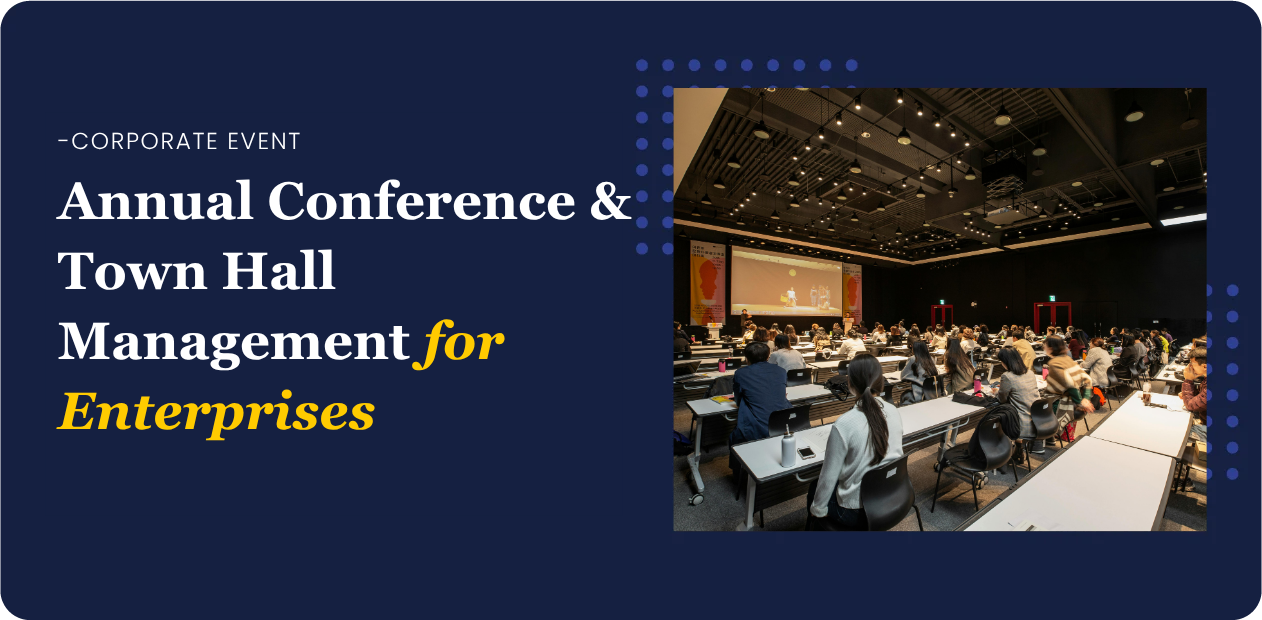

Annual conference and town hall event management covers the full build, format, venue, production, agenda, delegate logistics, hybrid delivery, and post-event reporting, run by one accountable team instead of six vendors. But annual conferences and town halls are not the same event. One is a production. The other is a conversation. EVENX runs both, and builds each differently.
Most internal teams are handed a 400-person event on top of their actual job. The cracks show on stage, a stream that drops, a Q&A nobody trusts, a venue that fits the headcount but not the format.
We take the whole build and run it as a single process. Here is what that covers.
Key Takeaways
- Annual conferences are outward-facing productions; town halls are internal alignment formats and need a different build.
- Format choice drives budget, lead time, and venue more than headcount does.
- Hybrid delivery fails on remote-audience parity, not on bandwidth; plan the Q&A, not just the stream.
- Engagement is a mechanism, not a mood: anonymous questions, live polls and moderated Q&A.
- Most companies never measure a town hall, so they repeat the same weak format every quarter.
What Annual Conference and Town Hall Event Management Covers?
Annual conference and town hall event management means one team owns venue sourcing, production, agenda design, delegate registration, travel, hybrid delivery, and post-event reporting. You approve decisions. You do not chase vendors.
In practice, that splits into three streams.
The build: venue, staging, AV, run-of-show, rehearsal.
The people: delegate registration, check-in, travel and accommodation, on-ground execution.
The content: agenda structure, speaker prep, Q&A design, and what you measure afterward.
Most MICE agencies stop at the first two. The third is where an annual conference becomes something people remember and a town hall becomes something people trust.
Annual Conference or Town Hall? Two Formats, Two Different Builds
An annual conference is a large event that happens once a year and focuses on sharing information and recognizing achievements. A corporate town hall is a shorter meeting that occurs regularly and is led by management. It aims to provide clear updates and answer questions. Both use similar planning, but they have different goals.
Here is how the formats compare:
| Format | Best For | Typical Size | Lead Time | Key Production Needs |
|---|---|---|---|---|
| Annual conference | Strategy, recognition, external guests | 200–2,000+ | 12–16 weeks | Full stage, LED, multi-track sessions |
| Company town hall | Leadership updates, alignment, Q&A | 50–5,000 (mostly hybrid) | 3–5 weeks | Clean audio, reliable stream, Q&A tooling |
| AGM | Statutory reporting, shareholders | 50–500 | 8–12 weeks | Formal setup, recording, compliance AV |
| Leadership offsite | Planning, decisions, small groups | 15–80 | 6–8 weeks | Breakout rooms, minimal staging |
| Hybrid multi-city meet | Distributed teams, company annual meet | 300–3,000 across sites | 8–12 weeks | Synced streams, local hosts, redundancy |
Here is where most companies get this wrong: they book a conference-sized venue for a town hall, then wonder why a two-hour session feels hollow in a 1,200-seat hall. Format first. Venue second.
Venue, Travel and Logistics for a Distributed Workforce
Venue selection is a capacity-and-format decision, not a headcount decision. The same hall seats roughly 40% fewer people in cluster seating than in theatre style, so the format you picked above sets your real capacity, not the venue’s brochure number.
Central venue or regional satellites?
If your team is in three or more cities, you may find it cheaper to host local venues with a synchronized stream instead of flying everyone to one convention center. We evaluate both options before making recommendations.
We manage vendor coordination, book hotels, arrange travel, and handle delegate registration and check-in to avoid delays. For internal town halls that discuss restructuring or finances, we set up access control and recording permissions before the event starts.
Production and Hybrid Delivery: Making Remote Attendees Equal Participants
Production covers stage, LED walls, sound, lighting, a written run-of-show, and a full technical rehearsal. That part is standard. What separates a good hybrid town hall event production from a bad one is whether the people at home are participants or spectators.
Three things decide that:
- Redundancy: A single uplink is a single point of failure. We run a backup path so a dropped connection costs seconds, not the session.
- Question parity: If in-room attendees raise hands and remote attendees type into a chat nobody reads, remote employees learn their questions do not count. Every question, room or remote, should enter the same moderated queue.
- Framing and audio: Remote viewers judge the event on what they hear. A camera locked on a wide shot with ceiling-mic audio makes a strong session feel like a security recording.
And here is the part nobody tells you: the rehearsal is where hybrid events are won.
Agenda, Leadership Q&A and Engagement That Isn't Theatre
A working agenda focuses on decisions, not departments. We create the run sheet with your leadership team, prepare speakers to address what the audience wants to know, and ensure the Q&A session is protected even if the CEO goes over time.
Engagement should be a process, not just a feeling. Here are effective ways to engage:
- Anonymous question submission: this is the best way to get honest questions that people won’t ask openly.
- Live polling: this helps check if the message is understood.
- Moderated Q&A: having someone organize questions allows leadership to address common themes instead of just answering random questions.
- Breakout sessions: these are useful for large conferences or offsites where not everyone can speak at once.
If you skip these methods, you risk ending up with a town hall where only a few loyal managers ask easy questions while everyone else waits for the recording.
Budgets, Lead Times and How You Know It Worked
A 200-delegate, two-day annual conference in a metro typically runs [VERIFY WITH TEAM PRICING: indicative range in INR]. A single-session hybrid town hall for the same headcount costs a fraction of that, because you are paying for reliability rather than scale.
Cost is driven by venue tier, headcount, number of days, production scale, hybrid streaming, travel and stay, and F&B, roughly in that order.
| Attendee Band | Recommended Lead Time | Critical Path |
|---|---|---|
| Under 150 | 4–6 weeks | Venue hold, AV scope |
| 150–500 | 8–12 weeks | Venue contract, travel blocks, speaker lock |
| 500–1,500 | 12–16 weeks | Multi-vendor contracting, hotel inventory |
| Multi-city hybrid | 12–16 weeks | Stream architecture, local host onboarding |
Then measure it. Attendance against registration. Q&A participation rate. A short post-event sentiment survey. And whether the action items announced on stage actually moved 30 days later. Most companies skip this entirely, which is why the same weak format repeats every quarter.
Conclusion
Whether you need annual day and town hall organizers for a single session or a town hall event management company to run a multi-city hybrid meet, the first step is the same: format, headcount, dates.
Send us those three, and we will come back with a scoped brief and an indicative budget within [VERIFY WITH TEAM turnaround, e.g. three] working days. No commitment, no retainer to see the numbers.
Get an event brief and indicative budget
Explore the full range of our corporate event management services.
Frequently Asked Questions
1. How much does corporate conference management cost in India?
For a 200-delegate, two-day conference in a metro, budget [VERIFY WITH TEAM PRICING]. Venue tier, production scale, and travel move that number most. Hybrid delivery adds a defined line item rather than a percentage. Share your headcount and format, and we will send a scoped range rather than a guess.
2.Can a town hall be run as a hybrid or virtual event?
Yes, most now are. The work is not the stream itself but question parity: remote attendees need their questions in the same moderated queue as the room. Our event brief specifies the stream architecture and Q&A routing for your specific setup.
3. How do you measure the success of a town hall?
Four measures: attendance against invited headcount, question volume and participation rate, a post-event sentiment survey, and 30-day follow-through on announced actions. We build the measurement plan before the event, because you cannot retrofit a baseline afterward.
4. How far in advance should you plan an annual conference?
Twelve to sixteen weeks for 500-plus delegates, eight to twelve for mid-size, four to six for a compact town hall. Venue inventory and speaker availability set the floor. Our brief maps your critical path against your target date.
5. What should a company town hall agenda include?
A business update, one thematic deep dive, and a protected Q&A block of at least twenty minutes. Keep the whole session under sixty. We build the run sheet with your leadership team so the Q&A does not get compressed.
6. What is the difference between an annual conference and a town hall?
An annual conference is a high-production, content-led event, often with external guests and multi-day scale. A town hall is a shorter, recurring, internal session built for leadership clarity and employee questions. Our format comparison in the event brief shows which fits your objective.