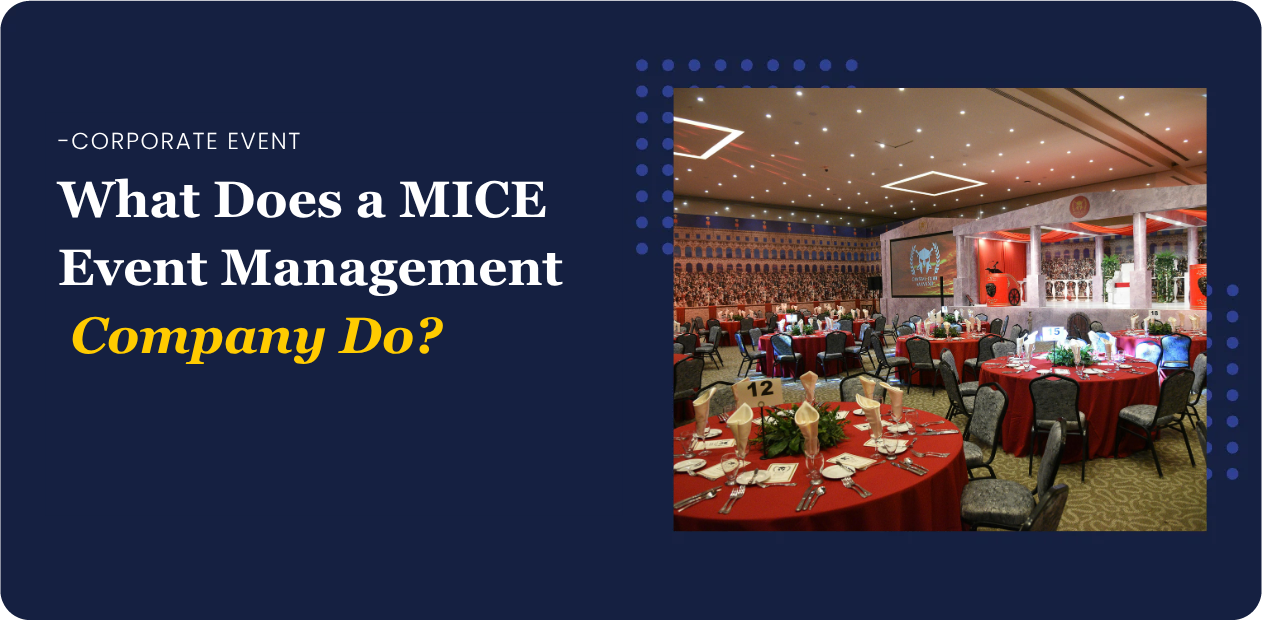

A MICE event management company plans and runs your business events, meetings, incentive trips, conferences, and exhibitions end to end, from destination and venue to delegate travel, on-ground delivery, and the post-event report.
But “we handle everything” is easy to say and hard to prove. Plenty of firms promise international delivery, then subcontract the moment your program crosses a border, and you find out on-site when it is too late to fix. The operators worth hiring have actually delivered across multiple markets expos in Las Vegas, conferences in Osaka with one accountable team rather than a chain of local vendors.
This guide covers what a MICE company does, what it costs, and how to tell a real partner from a reseller.
Key Takeaways
- A MICE company delivers meetings, incentives, conferences, and exhibitions end-to-end under one accountable team.
- Scope spans destination and venue, delegate management, travel, production, content, logistics, and post-event reporting.
- Hiring one saves internal time, reduces vendor risk, and usually secures better venue and travel rates.
- Cost depends on delegate count, destination, duration, and production scale; domestic and international prices differ.
- The real differentiator is proven international delivery with a single team, not domestic firms claiming global reach.
- MICE differs from corporate events: multi-day, travel-based, and often cross-border rather than single-venue.
What Is a MICE Event Management Company?
A MICE event management company is a specialist partner that designs and delivers business travel events under one roof. MICE stands for Meetings, Incentives, Conferences, and Exhibitions four formats that share one thing in common: your people, your clients, or your partners have to travel, stay, and be looked after for several days.
That is what separates MICE from ordinary event work. You are not booking a hall for an afternoon. You are moving a group of delegates to a destination, housing them, running a program, and getting everyone home without a single gap in the chain.
The four pillars in practice:
- Meetings: leadership offsites, dealer meets, sales kick-offs, and partner summits.
- Incentives: reward trips for top performers or channel partners, where experience quality is the whole point.
- Conferences: multi-track, multi-day events with speakers, content, and production at scale.
- Exhibitions: trade shows and expos where your stand, freight, and staffing decide the return.
Most brands touch two or three of these in a year. A MICE partner handles them all with the same team.
What a MICE Company Actually Handles?
Everything that happens between your initial request and your final report is crucial. This honest answer covers more than most buyers expect.
A full-service MICE partner handles:
- Destination and venue sourcing: shortlisting options, inspecting sites, negotiating rates, and signing contracts.
- Delegate management: registration, communication, room lists, and coordination on-site.
- Travel and accommodation: booking flights, arranging transfers, securing hotel blocks, and coordinating visas for international events.
- Production and AV: setting up the stage, sound, lighting, branding, and rehearsing technically.
- Content and speakers: designing the agenda, liaising with speakers, and planning session flow for conferences.
- Logistics and freight: building booths, shipping items, handling customs paperwork, and managing on-site setup for exhibitions.
- Post-event reporting: tracking attendance, engagement, spending against the budget, and evaluating outcomes.
Many companies make a mistake by splitting this work between a travel agent, a production vendor, and an internal coordinator. This often leads to gaps in responsibility. When a shipment clears customs late, multiple vendors blame each other, leaving your stand empty on day one.
Having one partner manage the whole process means you only need one number to call when something changes.
How a MICE Program Comes Together?
A well-run program follows the same five stages, whether it is a 40-person offsite in Goa or a 300-delegate expo overseas.
- Brief and objectives. What the event needs to achieve, for whom, at what budget. Everything downstream is judged against this.
- Destination and venue. Shortlist, site inspection, negotiation, and contracting chosen for flight access and delegate experience, not just room rates.
- Pre-program planning. Delegate registration opens, travel and rooming are locked, production is designed, and the run-of-show is built.
- On-ground delivery. The team arrives ahead of delegates, manages build and rehearsal, and runs the event with a live contingency plan.
- Post-program reporting. Reconciled spend, attendance and engagement data, and recommendations for the next cycle.
The stage buyers underestimate is the third. Pre-program planning is where 80% of the work sits, and where a partner who has run cross-border programs before will catch the problems – visa lead times, freight windows, hotel release dates that a first-timer meets on arrival.
Why Companies Hire a MICE Partner Instead of Running It In-House
Because the internal cost is real, even when it never appears on an invoice.
Running a 200-delegate conference in-house typically pulls two or three people off their actual jobs for six to eight weeks. Your marketing lead becomes a travel coordinator. Your HR manager chases rooming lists. Neither has the vendor relationships to negotiate hard, so you pay published rates on venues, rooms, and production.
A MICE partner brings three things you cannot build for one event a year: buying leverage across many programs, a delivery playbook that has already failed and been fixed elsewhere, and enough on-ground people to run the event without borrowing yours.
The trade-off is honest you pay a management fee. For a single small meeting, in-house often makes sense. Above roughly 100 delegates, or the moment travel crosses a border, the fee is usually smaller than what the alternative costs you in time, risk, and rates.
How Much Does It Cost to Hire a MICE Company?
There is no flat rate, but pricing follows a predictable structure. Most MICE companies quote either a percentage management fee on total program value or a fixed project fee, and the number moves on five drivers:
| Cost Driver | What Moves the Price |
|---|---|
| Delegate count | Registration, rooming, transfers, and on-ground staffing all scale per head. |
| Destination | Domestic programs cost less than international events; visas and freight add complexity. |
| Duration | Each additional day increases accommodation, F&B, and crew costs. |
| Production scale | A stage-and-screen setup costs significantly less than a full-scale conference production. |
| Format | Exhibitions require booth fabrication and freight, unlike standard meetings. |
Ask for the fee model in writing at the proposal stage, and check whether vendor commissions are passed back to you or retained. That single question separates transparent operators from the rest.
MICE vs Corporate Events: What Is the Difference?
They overlap, but they are not the same job.
| Factors | MICE Events | Corporate Events |
|---|---|---|
| Duration | Multi-day | Usually single-day |
| Travel | Delegates travel and stay | Local or in-house attendees |
| Scope | Destination, travel, accommodation, program | Venue and program |
| Geography | Often multi-city or cross-border | Single location |
| Complexity | Visas, freight, rooming, transfers | Venue logistics |
An annual town hall at a city hotel is a corporate event. Flying 150 channel partners to Dubai for a three-day incentive program is MICE. If you are planning the former, our corporate events team is the better fit.
How to Choose the Right MICE Event Management Company?
Every company on your list claims to offer complete services and global reach. To verify this, evaluate how a true provider stands apart from a reseller by focusing on the six key factors that determine your program’s success or failure.
Start with international delivery, because it exposes a reseller the fastest. Ask which specific events they have run outside India, in which cities, and in what year. A real operator names them without hesitation: AAPEX or CONEXPO in Las Vegas, a showcase in Osaka. A reseller says “we work globally” and moves on.
Then check accountability. Find out who is physically on-site and whose payroll they are on. If delivery is handed to a local partner you will never meet, you are buying a subcontract with a markup, not a team that owns your outcome.
The next two are about capability. Delegate management should run in-house; registration, rooming, and travel under one roof means fewer handoffs and a single source of truth on numbers. Production matters just as much: multi-track content and full-build exhibition stands need genuine capability, not a coordinator who subcontracts the hard part and adds a margin.
Finally, the two that predict how the relationship will actually run. Ask for references from a comparable program, same delegate size, same format, ideally the same region, and call one. And insist on fee transparency: get the fee model in writing at proposal stage, and ask whether vendor commissions are passed back to you or retained. How openly a firm answers that question tells you most of what you need to know.
Work through those six in order, and the field narrows quickly. If you only have time for one question, make it this: “Which of these events did your own team run on the ground, and who can I call to confirm it?” A real operator answers in specifics. Anyone else changes the subject.
Ready to Plan Your Next MICE Program?
The difference between a program that runs and one that unravels is almost never the venue. It is whether one team owns every link in the chain travel, delegates, production, freight, and the report at the end.
EVENX has delivered MICE programs across 5+ international markets for brands including JK Fenner, Syngene, Agilent, and Motherson.
Share your brief and our team will respond within one business day.
Plan Your MICE Program · Explore our MICE services · See our work
Frequently Asked Questions
1. How much does it cost to hire a MICE company in India?
It depends on delegate count, destination, duration, and production scale, and is usually quoted as a management fee on total program value or a fixed project fee. Share your delegate numbers and destination and we can give you an indicative range for your program.
2. How is a MICE company different from a DMC?
A destination management company operates in one destination and delivers the ground portion: venues, transfers, local experiences. A MICE company owns the full program across every location, including your delegates before they land and your reporting after they leave. Many MICE partners appoint DMCs; you should only manage one relationship.
3. Does a MICE company handle international events and visas?
Yes, a full-service partner coordinates visa documentation, invitation letters, and appointment scheduling alongside flights and accommodation. Check whether it is handled in-house or passed to an agency, and confirm they have delivered in your target country before.
4. How far in advance should you book a MICE company?
Plan four to six months ahead for international programs and 90 to 120 days for domestic ones. Peak season, large delegate counts, and exhibition freight all push those windows earlier.
5. What does MICE stand for?
Meetings, Incentives, Conferences, and Exhibitions. It covers business events where delegates travel and stay, as opposed to single-venue local events.