
A successful team-building event happens when you align the activity with a clear goal, plan for 8 weeks, and designate one person in charge of everything. It doesn’t work if you book a venue first and figure out what you want to achieve later.
You are organizing the next event. You have a budget, a number of people, and a date. What you might lack is the confidence that this event won’t be like last year’s, forced, costly, and forgotten by Monday morning.
This problem is fixable. It usually comes down to three planning mistakes: picking the activity before the goal, leaving logistics until the last two weeks, and failing to follow up after the event. Address these three issues, and the event can become a valuable experience that leadership mentions during the next budget review.
This guide provides a clear approach: matching the goal to the activity, a complete planning timeline, and help in choosing a location in India or abroad. EVENX uses this approach for companies across pharma, finance, tech, and manufacturing in Delhi-NCR, Mumbai, Bengaluru, and international locations.
You can either manage it yourself or designate a single point of contact. Here’s what a real team-building event should look like before you book anything.
Key Takeaways
- Match the activity to a defined objective first: communication, trust, or cross-functional alignment, never the reverse.
- Gallup finds highly engaged teams run 23% more profitably than disengaged ones, yet only 21% of employees globally report feeling engaged.
- Plan same-city indoor events at least 6 weeks out; plan offsites requiring travel at least 8 weeks out.
- India’s top offsite clusters Manesar, Neemrana, Lonavala, Coorg, and Goa suit different group sizes, seasons, and budgets.
- Multi-vendor events have no built-in point of accountability; every logistics gap defaults to the internal organizer.
- A specialist partner like EVENX frequently costs less than DIY planning once negotiated vendor rates are factored in.
What Are Corporate Team Building Events (and Why Do Most Fail)?
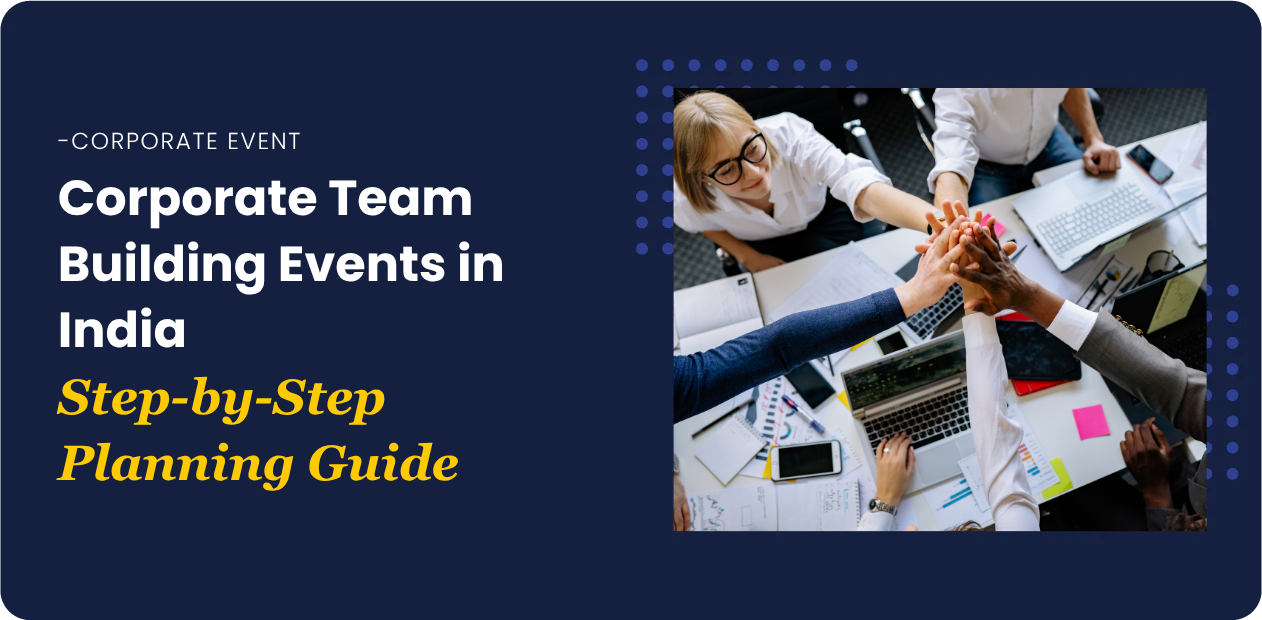
Corporate team-building events are structured activities with a defined objective, run by a facilitator, designed to improve how people work together outside routine tasks. A company party, a conference, or an offsite full of back-to-back presentations doesn’t qualify.
That distinction matters because teams use the term loosely, and loose definitions waste budget.
A genuine event has three characteristics:
- A defined objective: communication, trust, cross-functional alignment, morale, or leadership development
- Structured activities: designed to produce that outcome, not just fill a day
- Facilitation: someone actively managing the experience, not just supervising it
Event formats can vary greatly. You might have a half-day indoor session for 30 people at your office, a full-day outdoor challenge for 150 people at a resort near Mumbai, or a two-day offsite in Coorg with a mix of planned activities and free time. Purposeful design connects all these options.
Companies often organize these events when onboarding large groups of new hires, managing teams through leadership changes, helping teams adjust after remote work, or setting up annual engagement programs. After you identify the goal, you can choose the type of activity that fits.
Types of Corporate Team Building Events (Matched to Your Objective)
The right activity depends entirely on the objective you’re solving for a ropes course builds trust, but it won’t break down cross-departmental silos the way a hackathon-style innovation sprint does. Choose the objective first, then match it against this table before you pick a format.
| Objective | Recommended Activity | Best Format |
|---|---|---|
| Improve communication | Improv/theatre workshop | Indoor |
| Build trust | Ropes course / Outdoor challenge | Outdoor |
| Cross-functional alignment | Hackathon / Innovation sprint | Indoor or Hybrid |
| Morale and fun | Cooking competition / Quiz | Indoor |
| Leadership development | Simulation / Strategy war game | Indoor or Outdoor |
| New hire integration | Scavenger hunt / Team quiz | Indoor or Outdoor |
| Large group (200+ pax) | Corporate sports day / Olympics | Outdoor |
| CSR integration | Charity build / Tree planting | Outdoor |
Indoor events happen all year round, no matter the weather. This makes them a good choice for city-based groups that can’t travel far. Activities like escape rooms, cooking competitions, quiz nights, and strategy simulations are great options. For groups larger than 150 people, it’s important to have multiple activities running simultaneously to keep everyone engaged.
Outdoor events boost energy levels and offer teams a real break from the office. These events are especially helpful for improving morale or for teams that don’t often interact. Options like ropes courses, sports days, and trekking challenges in places like Lonavala, Coorg, or Rishikesh create shared travel memories. However, they require careful planning for transport, weather, and safety.
Hybrid events help on-site and remote employees participate equally in teams spread across different Indian cities. A skilled facilitator can run activities for both groups simultaneously and encourage interaction between the locations. If the objective is employee wellbeing rather than team bonding, a corporate health event is the better format.
During the first discovery call, EVENX’s planning team identifies the best activity based on your goals. They recommend one activity format. This is why it’s important to consider whether the investment is worthwhile before you commit your budget.
Why Do Corporate Team Building Events Deliver Measurable ROI?
Team-building events pay for themselves through four measurable business outcomes: lower attrition, faster morale recovery after organizational change, stronger cross-department collaboration, and quicker new-hire productivity.
Large Indian enterprises, particularly in pharma, banking, manufacturing, and tech, face the same structural problem: departments operating in isolation. Sales teams miss operational constraints. Product teams don’t see what customer service deals with on a daily basis. Finance rarely understands what business development is chasing. A well-designed cross-functional event breaks down that isolation without waiting for a crisis to force the issue.
Four outcomes tie directly back to the business case:
- Employee retention: Engaged employees stay longer, and replacing a mid-level hire costs 50–200% of their annual salary in recruitment, onboarding, and lost productivity. Retaining even one or two employees longer covers the cost of a well-run event several times over.
- Post-change morale: Restructures, leadership transitions, and return-to-office mandates all drag engagement down. A well-timed event signals that the company values its people, not just its strategy.
- Cross-department collaboration: Shared experiences outside of work build trust faster than shared Slack channels do, thereby shortening approval cycles and speeding up decisions.
- New-hire integration: Faster relationship-building gets new hires to full productivity sooner, which shows up directly in ramp-time metrics.
Gallup’s meta-analysis across thousands of business units backs this up: highly engaged teams deliver 23% higher profitability than disengaged teams, yet only 21% of employees worldwide report being engaged, leaving most organizations leaving that gap unclaimed.
EVENX builds every proposal around one of these four outcomes so the event ties back to a result your leadership can actually measure, not just a day everyone enjoyed. The bigger risk to that ROI isn’t the activity; it’s when you start planning.
How Do You Plan a Corporate Team Building Event?
Plan a same-city indoor event at least 6 weeks out and an offsite at least 8 weeks out. Most events fail not from a bad activity choice but from starting the planning sequence too late.
Weeks 8–6: Define the objective and lock the budget
Before booking anything, write down the specific behavior or relationship change you want. Every downstream decision activity, venue, facilitator, format should trace back to that answer. Secure budget approval here, not after you’ve already picked a venue.
Weeks 6–4: Shortlist venues and vendors, confirm headcount
Narrow down 2–3 venue options and 2–3 vendor options. Lock your working headcount at 90% of the invited list. Collect dietary and accessibility requirements now so they shape venue and catering decisions. Brief vendors on objective, group size, format, and budget range.
Weeks 4–3: Confirm vendor and venue, send the save-the-date
Sign contracts. Send attendees the date, location, duration, and dress code early; it reduces last-minute changes.
Weeks 3–2: Confirm logistics, brief facilitators
Lock transport for offsites (bus bookings, departure times, route). Confirm A/V, catering, and arrival logistics. Brief facilitators on group composition and objectives. Good facilitators adjust their approach to the room, so they need the context in advance.
Weeks 2–1: Send the attendee briefing
Give attendees the schedule, what to bring and wear, and what the day involves. People who show up without knowing what to expect spend the first hour settling in instead of participating.
Event day and after:
Arrive early, brief the facilitation team, confirm logistics on-site, and run a debrief before people leave. 20 minutes of structured reflection meaningfully increases what people carry back to work. Send a post-event survey within 48 hours, then review results within two weeks and file them for next year’s planning.
A clear vendor brief should include the following key points: group size, main goal, budget per person, preferred format, preferred location or distance from the office, date range, and any specific needs, such as dietary restrictions, accessibility, or company policies on physical activities.
This is the exact order EVENX’s project managers follow for every offsite event. There is one point of contact from Week 8 until the post-event debrief. This single-owner approach is what makes their execution difficult to replicate in-house.
Where Should You Host a Corporate Team Building Event in India (and Beyond)?
Delhi-NCR teams default to Manesar or Neemrana; Mumbai teams to Lonavala or Karjat; Bengaluru teams to Coorg; and any pan-India group of 200+ to Goa. The right destination depends on group size, season, and whether attendees are flying in.
Most team-building advice online targets US or European audiences, and it doesn’t transfer. Lonavala isn’t the Hamptons. Coorg isn’t the Lake District. A plan built on generic Western advice misses the logistical realities specific to each Indian cluster.
By city:
- Delhi NCR → Manesar (30–45 min, large conference resorts), Neemrana (90 min, heritage resort, well-suited to senior leadership offsites), Rishikesh (5–6 hrs, adventure and wellness formats, gaining traction for 2–3 day events), Corbett (5–6 hrs, wildlife setting, premium tier)
- Mumbai → Lonavala (2 hrs, most popular, widest venue range), Karjat (2 hrs, outdoor adventure focus), Alibaug (ferry or road, beach setting, boutique resorts), Goa (flight or overnight, best for 2–3 day events of 100+ people)
- Bengaluru → Coorg (4–5 hrs, coffee estate stays, best for 2-day events), Chikmagalur (5 hrs, similar profile, less crowded), Kabini (4–5 hrs, wildlife setting, premium)
- Pan-India → Goa handles large groups flying in from multiple cities better than anywhere else; its venue infrastructure and accommodation density comfortably support 200–500-person events
City-based indoor venues work when offsite travel isn’t feasible due to budget, short notice, or monsoon timing. Delhi, Mumbai, Bengaluru, Hyderabad, Pune, and Chennai all support same-day indoor events for up to 500 people, backed by local facilitation vendors.
Weigh three factors before you commit: group size (50–100 fits boutique resorts; 200–500 needs dedicated conference and outdoor infrastructure most boutique properties can’t handle without custom setup); season (plan outdoor events outside monsoon, and always confirm an indoor fallback if monsoon is unavoidable); and flight vs. road access (groups flying in from multiple cities need a destination near a functioning airport, since road-only locations create logistics problems at scale).
For enterprises with teams outside India, EVENX applies this same planning framework to offsites at international locations; the destination changes, the sequencing doesn’t. Once you’ve settled on a destination, the real decision is who executes the plan.
Should You Hire a Corporate Event Management Company or Run It In-House?
Hire a specialist once your event involves more than one vendor. Internal teams handle single-vendor, single-city events fine, but multi-vendor coordination has no natural point of accountability, and every gap between vendors lands on the organizer’s desk.
Here’s what actually plays out in-house: one person books the venue, another arranges transport, a third briefs the activity vendor, and facilities handles catering. On event day, the same logistics person must also participate. When a bus runs late, the venue isn’t ready, or a facilitator shows up unbriefed, the organizer ends up firefighting instead of running the event.
That’s not a capability gap; it’s a structural one. No single person owns the seams between vendors, and nobody’s sole job on the day is making sure the event actually works.
A corporate event management company closes that gap with one point of contact who handles venue negotiation, activity design, vendor briefing, logistics and A/V, on-site coordination, facilitator oversight, and post-event review, eliminating the communication gaps that cause day-of failures.
Hiring professional management usually doesn’t raise your cost, either. A company that books venues and vendors at scale typically negotiates better rates than an internal team making one-off arrangements, and better procurement often covers the entire management fee.
EVENX has run corporate team-building events across India and internationally for enterprises in pharma, BFSI, technology, manufacturing, and consumer goods, managing this multi-vendor coordination so your team doesn’t have to.
Conclusion
A successful corporate team-building event comes down to a clear objective, an 8-week planning runway, and one accountable owner running execution. Events fail when the activity gets picked before the objective, and when execution falls to people juggling other full-time responsibilities. The longer planning gets delayed, the harder recovery becomes.
You now have the framework: match objective to activity, follow the 8-week timeline, choose the right India (or international) destination, and measure what worked. The one variable that determines whether it all comes together cleanly is who owns execution.
If you’re planning a corporate team-building event and want it executed without the internal firefighting, tell EVENX your group size, objective, location, and timeline. We’ll recommend the format and give you a budget range before you book anything.
Frequently Asked Questions
1. What factors affect the cost of a corporate team-building event in India?
Four factors drive cost: group size, event type (city-based indoor vs. offsite), activity type, and vendor quality. City-based indoor events for 50–100 people run ₹800–₹2,500 per person. Offsite events, which include accommodation and transport, run ₹3,500–₹12,000+ per person. Travel and accommodation inclusion is the single biggest cost swing.
2. Can team building events work for large corporate groups?
Yes, but the design has to change as group size grows. Events above 100 people need smaller breakout areas so everyone stays active. Groups of 200+ need venues that run multiple activities simultaneously. At 500+, the event functions more like a festival, with parallel stations and a clear participant flow.
3. How do you plan a corporate team-building event?
Start with the objective, not the activity. Define the behavior or relationship outcome you need, set the budget, then choose vendors that serve that goal. Follow the 8-week sequence: lock objective and budget in weeks 8–6, select vendor and venue in weeks 6–4, confirm logistics in weeks 4–2, brief attendees in week 1, and measure success within 48 hours of the event. EVENX can run this entire sequence for you.
4. What are corporate events for team building?
They’re structured activities that build communication, trust, collaboration, or morale through shared experiences outside normal work, distinct from company parties (social, unstructured) or offsites (which may run strategy sessions with no team-building component) because they carry a defined objective and activities built to hit it.
5. What are the benefits of team-building activities for employees?
Three benefits stand out: stronger cross-team collaboration, better employee retention, and faster morale recovery after organizational change. Gallup research shows that engaged teams operate 23% more profitably than disengaged teams. Employees who go through well-run events feel more valued, which keeps them at the company longer.
6. What is the difference between indoor and outdoor team building?
Indoor events stay controlled and weather-independent, which suits city-based groups that can’t travel best for communication-focused activities, simulations, and creative challenges. Outdoor events deliver more energy and a stronger break from the office, better for trust-building and adventure-based formats. The right choice depends on objective, group size, season, and budget.
7. How often should companies organize team-building events?
Standard HR practice runs one meaningful event per quarter, plus smaller monthly touchpoints. Most Indian enterprises run one large annual offsite and 1–2 smaller city-based events through the year. Consistency drives engagement more than scale; a regular cadence of well-designed events beats one large annual event with nothing in between.